
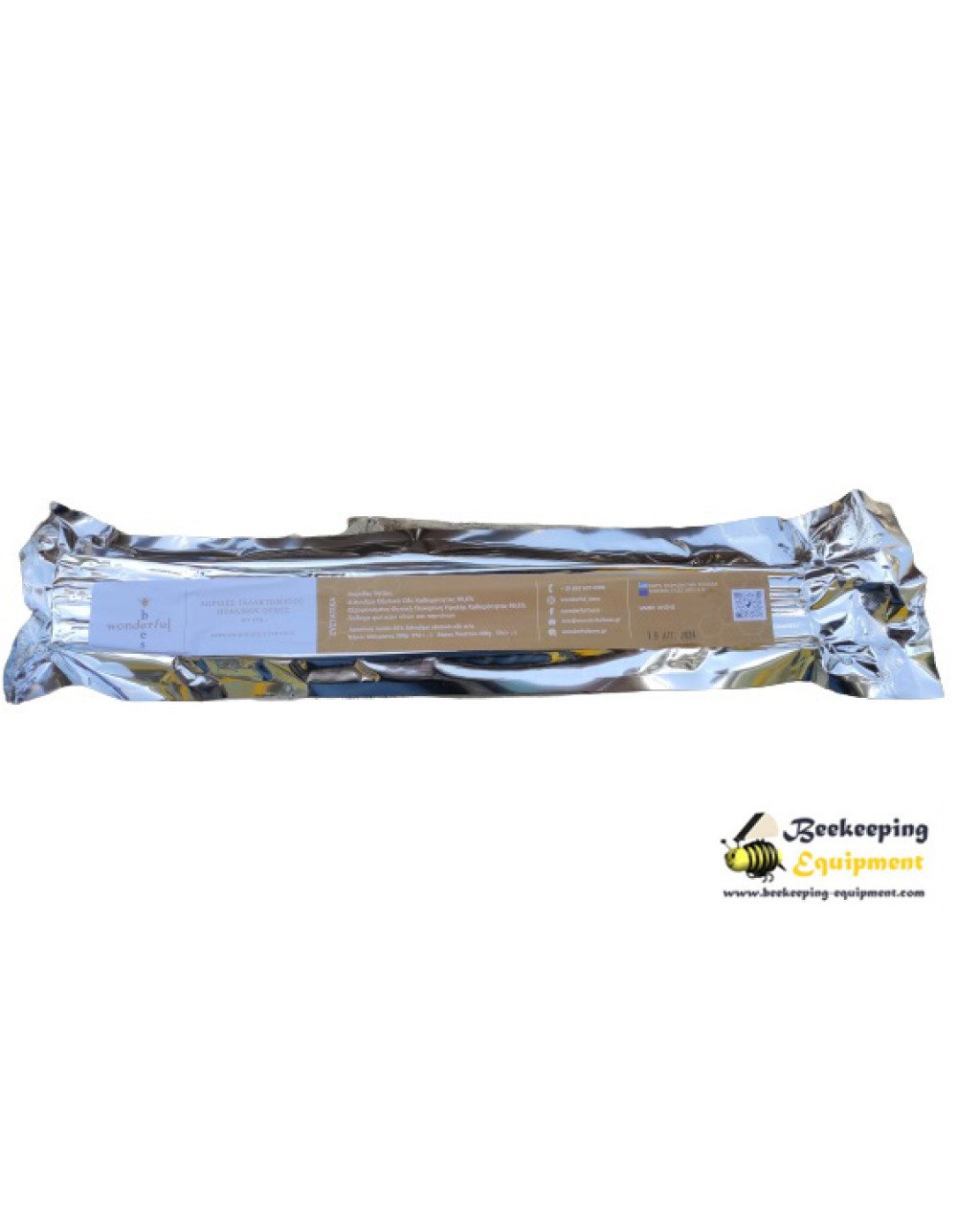
Oxalic acid is one of the strong organic acids with the chemical formula C2H2O4. It is a white solid, relatively strong carbonic acid. We find it in nature in concentrations in sorrel (commonly known as nettle) and in many other plants such as black pepper, parsley, poppy seeds, amaranth, spinach, Swiss chard, beets, cocoa.
Oxalic acid strips are essentially cut cellulose strips soaked in a complete homogenized solution of Glycerin and Oxalic Acid in the proper proportions. The active substance oxalic acid due to the low Ph has an acaricidal effect against Varroa, however the addition of glycerin significantly prolongs the action of oxalic acid because as a viscous non-volatile substance it binds the acid providing a slow release from the cellulose strips which can accordingly season to range from 25-40 days. The ¨collaboration¨ of glycerin with oxalic acid combined with the appropriate absorbent material (cellulose) provides a high and prolonged effectiveness in a 100% ecological way, which makes it an excellent treatment significantly inhibiting varroa even with the presence of brood in the colony with efficiency rates <90%.
Oxalic acid strips are suitable for a wide range of temperatures from 15 -35 degrees Celsius. Since oxalic acid works by contact, below 15 degrees we have low movement of bees in the frames and therefore less contact of different bees with the tapes, which delays and perhaps reduces the effectiveness of the treatment with possible negative consequences in failure. At temperatures above 35 degrees we have a faster release of oxalic acid from the strips with possible negative consequences for the health of the colony. In summary, we avoid using Winter in low temperatures and during periods of intense heat.
Oxalate strips to be effective must ALWAYS be placed in the frames where brood is present. This is due to the fact that Varroa reproduces in the brood and young bees and queen bees always have the highest infestation and since the oxalic acid works in contact in this way we maximize the spread of the active substance in the infected population. However, we do not need to place absolutely in the center of the frame disturbing the movement of the bees. We can place them in a ¨Λ¨ formation 5-7 cm from the imaginary center of the frame and alternately. We fold the strips and “wear” them in the frame that has a brood.
Also we can cut them in half and place 2 halves hanging with a toothpick, instead of one whole folded. The difference is that when they are half balanced in the gap of the frames it leaves a better corridor for the bees and the queen to pass through. It also reduces “dimpling” of the wax in the frames. However, the disadvantage is that it takes significantly more time to place them in the colonies.
No risk of contaminating honey or wax, in fact oxalic acid is a component of honey and belongs to the organic compounds. That is why the method of managing varroa with oxalate strips has a biological approach.
The program below is indicative and adapted according to the climate and beekeeping activities . Obviously modifications can be made according to the current needs, however the following advantages are presented if you follow it.
Its aim is:
We choose this period because the temperatures reach 17-20 degrees Celsius so it is a suitable temperature to apply oxalic acid strips to beehive between 6-8 frames population.
We apply a maximum of 1-2 strips of oxalic acid from 20-30 days to reduce the number of mites from those that survived the Winter as well as external contamination from other Bees.
In beehives under 3 frames we do not put the spring season in order not to negatively affect the development of the bee season. We also do not let the beehive reach 10 frame population without applying oxalate strips because at this size it will maintain 7-8 frames, so the effectiveness of the treatment will be reduced if the varroa go inside in so much brood cells.
We should keep in mind about the appropriate circumstances. If, despite the season and the month, there is prolonged cold and rain, it is better to wait a bit to stabilize the weather. We don’t want to burden our colonies with the wrong application of treatment in the growing season.
Usually within this time period we have the Forest honey harvests, so we have less brood frames and more honey.
So having favorable conditions and as long as the upper temperatures do not exceed 35 degrees Celsius, we apply oxalate strips to the beehives where we have already collected the honey.
Usually the colonies are on 2 floors at that time, so during the harvest we organize the hive properly by taking down to the first floor all the brood frame and placing 4 strips of oxalate in the hive. We also place another strip on the upper floor (if it has one) in a central frame. In total, depending on the size of the colony, we apply 4-5 strips of oxalate for 30 days.
*IMPORTANT: It will be better for convenience and time saving to apply the oxalate strips during our harvest so that we do less operations on our bees. And also if not on the day of harvest it should be within the first 3 days after that to give the strips enough time to kill the varroa while it is exposed. If we delay and the queen increase the spawning rate (More new Brood) there is a risk through our own negligence the varroa entering the new brood making them infected and even if treatment is applied afterwards, the damage has been done and the effectiveness will not be as high.
Usually in this time period we have very little frame broode because is full honey, a good opportunity to fight the varroa.
Usually the colonies are smaller than in May and June at that time, so during the harvest we place 3-4 strips of oxalate for 30 days in the central frames of the bee. Also, because in the months of August-September has been observed bigger entry varroa from other neighboring colonies , we monitor and count in some of our hives the sum of the killed varroa and if it is big enough (eg 300, 500, 800 varroa) maybe repeat one more treatment cycle in first 20 days with perhaps fewer strips (20+20=40 Days). It is perhaps the most critical application in the month of August because the varroa must be reduced enough so that the following autumn will be as “clean and sanitary” from varroa as possible. So need Attention!
Usually around this time we have the last treatment application we will do with oxalic acid strips as the temperatures are close to 17-20 degrees celsius and any further drop in temperature will not allow the use of oxalate strips.
Usually the colonies are still smaller than in the spring and summer at that time, so during the harvest of the Fir we place 1-2 strips of oxalate for 30 days in the remaining brood frames. After the bees they have low varroa level to “welcome” in a few weeks the Winter as they gradually reduce their brood .
From mid December – January the temperatures are quite low 3-10 degrees Celsius and our bees no longer keep brood. This will be the last and important treatment to close the beekeeping season.
Any remaining varroa is now completely exposed. We should not apply oxalate strips again due to low temperatures, so we recommend applying 2 sublimations of oxalic acid or 1 cycle of treatment with approved amitraz strips (Apivar ) if we do not practice organic beekeeping. This way we will reach almost zero varroa percentage in our colonies.
*IMPORTANT: Keep in mind that even though it is Winter, when the right treatment is applied and the conditions and temperature are not as high as possible in the following days (e.g. <10 degrees) so that the bees can move for some hours in the hive and especially at lunchtime hours when the temperature rises not to be a “tight ball” due to low temperatures, so that the treatment has maximum effectiveness and does not negatively affect the health of the bees.


At Bulku Veterinary, we are committed to delivering high-quality veterinary pharmaceuticals and products to support the health of animals across Albania. With a strong focus on innovation, sustainability, and animal welfare, we provide reliable solutions for veterinarians, farmers, and pet owners alike.

Got Questions? Call us 24/7
Sunday
7:00 am – 11:30 am
Monday – Friday
6:30 am – 6:00 pm
Copyright © 2025 Bulku Veterinary | All rights reserved. Developed By: Web Solution Hub


Reviews
There are no reviews yet.